Most Accurate Bible Translation (2026 Comparison)
TL;DR
There's no single most accurate Bible translation—accuracy depends on how you read. The NASB is the most literal, ideal for deep study and word studies; the ESV balances precision and readability; the NIV blends both for daily reading; and the NLT is meaning-based for new readers. Every major version is trustworthy scholarly work—differences come down to style, not right or wrong.
Most Accurate Bible Translation: Which Version Gets Closest to the Original?
If you've ever searched for the most accurate Bible translation, you know there's no simple answer. That's because "accuracy" means different things to different readers. The good news? There's a version that fits exactly how you want to read Scripture.
Maybe you want to study each word closely. Or maybe you want a version that reads smoothly in plain English. Either way, knowing how Bible versions work will help you find your best fit. Let's walk through it together.

What Makes a Bible Translation "Accurate"?
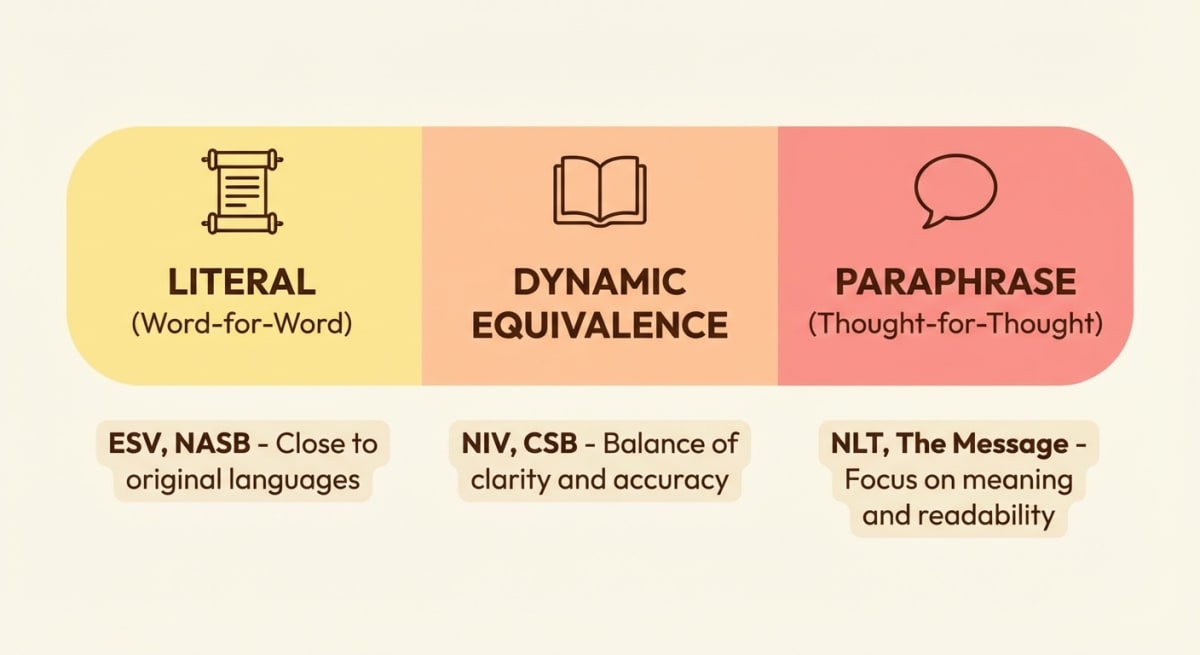
Before we compare versions, let's look at how they're made. Every Bible version falls somewhere on a scale between two styles:
Word-for-word versions try to match the Hebrew and Greek as closely as they can. They keep the same word order and phrasing, even when it sounds a bit stiff in English.
Thought-for-thought versions focus on the meaning of the text in clear, modern English. They may reshape a sentence so it reads smoothly while keeping the core message.
Paraphrase versions take even more freedom. They restate ideas in casual, everyday language. They're great for light reading but less useful for close study.
Here's the key: no style is "wrong." A word-for-word version isn't always better than a thought-for-thought one. They just serve different needs. A literal version gives you precision. A freer one gives you clarity.
The Most Accurate Bible Translations Ranked
Let's look at the major versions from most literal to most readable. Find the one that speaks to you.
1. NASB (New American Standard Bible)
Style: Word-for-word (most literal)
The NASB is widely seen as the most literal Bible translation in English. It follows the Hebrew and Greek word order as closely as it can. This makes it a top pick for deep study.
Strengths:
- Stays very close to the source languages
- Uses the same English word for the same Greek or Hebrew word
- Great for word studies and cross-checks
Best for: Deep study, Bible school, and readers who want to get as close to the source text as they can.
Keep in mind: The English can feel stiff at times — that's the trade-off for being so precise. For example, where the NIV might say "So I say, walk by the Spirit," the NASB reads "But I say, walk by the Spirit" — keeping the original linking word.
The 2020 update made it easier to read while staying just as precise.
2. ESV (English Standard Version)
Style: Word-for-word (with smoother English)
The ESV hits a sweet spot between being precise and easy to read. It's mostly literal but smooths out the English just enough to flow well. Many see it as the best of both worlds for daily Bible reading.
Strengths:
- Very close to the source languages
- Reads more smoothly than the NASB
- Used widely in churches and study groups
Best for: Daily reading and study, church use, and learning verses by heart. If you're weighing the ESV vs NIV, the ESV leans more literal while still being easy to follow.
3. KJV / NKJV (King James Version)
Style: Word-for-word
The KJV has been loved for over 400 years — and for good reason. Its team of scholars did careful, faithful work. The NKJV updates the old-style language while keeping the same approach.
Strengths:
- Beautiful, poetic language
- Long history of trust among scholars
- NKJV makes it easy for modern readers
Best for: Readers who love the beauty of poetic English, learning verses by heart, and classic worship. See our KJV vs NIV guide for a closer look.
4. NIV (New International Version)
Style: Balanced (word-for-word meets thought-for-thought)
The NIV is the world's most popular modern Bible, and it earns that spot. It blends precision with clear English, making it easy to read without losing meaning.
Strengths:
- Clear, natural English
- Strong balance of precision and readability
- Great for all levels of readers
Best for: Daily reading, new believers, and group study. Want to see how it stacks up against other easy-to-read versions? Check our NIV vs NLT guide.
5. NLT (New Living Translation)
Style: Thought-for-thought
The NLT puts the meaning of Scripture into the most natural English it can. It's clear, warm, and a joy to read — especially if more literal versions feel heavy.
Strengths:
- Very easy to follow
- Captures the heart and feeling of each passage
- Great for reading large chunks at once
Best for: New Bible readers, quiet time reading, and anyone who wants Scripture to feel like a chat with a friend. It's one of the easiest Bible versions to pick up.
The NLT shines when you read longer stretches — like a whole book in one sitting. It flows so smoothly that you can focus on the story without getting stuck on hard phrasing.
6. The Message
Style: Paraphrase
The Message isn't a standard version — it's a retelling by scholar Eugene Peterson. He put Scripture into casual, everyday words. Think of it as a friend telling you what a passage means.
Strengths:
- Fresh take on passages you've read before
- Very easy and fun to read
- Helps you see Scripture with new eyes
Best for: Reading alongside a more literal version. Not the best pick as your only Bible for study.
Bible Translation Comparison Chart
Here's a quick bible translation accuracy chart to help you compare at a glance:
| Version | Accuracy Type | Readability | Best Use |
|---|---|---|---|
| NASB | Most literal | Fair | Deep study |
| ESV | Very literal | Good | Study + daily reading |
| KJV/NKJV | Literal | Fair (KJV) / Good (NKJV) | Verses by heart, worship |
| NIV | Balanced | Very good | Daily reading |
| NLT | Meaning-based | Great | Quiet time, new readers |
| The Message | Paraphrase | Great | Fresh views |
Which Version Should You Choose?
The best version depends on how you plan to use it. Here's a simple guide:
For deep study: NASB or ESV — you'll see the source languages most clearly.
For daily reading: NIV or ESV — precise enough to learn from, smooth enough to keep going. A Bible reading plan can help you stay on track.
For learning verses: ESV or KJV — the phrasing sticks in your mind.
For new readers: NLT or NIV — clear, warm language that won't slow you down. Our guide on how to read the Bible can help you build a rhythm.
For a fresh view: The Message or NLT — they'll show you familiar passages in a whole new light.

How Bible Versions Are Made
It's worth knowing what goes into making a Bible version. Modern versions are built by large teams of scholars — often 50 to 100 or more experts in Hebrew, Aramaic, and Greek. These teams also include language and style experts who work together for many years.
The source texts matter too. Most modern versions use the best and oldest texts we have, including the Dead Sea Scrolls (found in 1947). This means newer versions like the ESV and NASB2020 draw from older, more reliable texts than the KJV team had in 1611.
Every version also goes through many rounds of review. The NIV, for example, has a full-time team that checks and refines the text as new findings come to light.
The bottom line? You can trust that every major version on this list is the work of careful, serious study. The gaps between them come down to style, not right or wrong.
Can You Use More Than One Version?
Yes — and many longtime readers say you should!
Reading the same passage in two or three versions is one of the best ways to go deeper. A literal version like the NASB shows you the exact words. A freer version like the NLT helps you grasp the bigger picture. Together, they paint a fuller image.
Here's a simple way to do it:
- Read a passage in your main version (the one you like most)
- Check a key verse in a more literal version for precision
- Look at a freer version if something feels unclear
Many Bible study methods use this kind of side-by-side reading. You don't need to pick one version for life — feel free to explore.
Some readers keep two Bibles on hand: one for study (like the ESV or NASB) and one for quiet time (like the NLT or NIV). Others use apps that let you switch versions in a tap. There's no single "right" way — the goal is to engage with Scripture in a way that feels real to you.
If you want a simple way to read the Bible every day, pairing a reading plan with your favorite version can make all the difference.
Start Reading with Confidence
The most important thing isn't which version you pick — it's that you start reading. Every version on this list is the work of scholars who care deeply about sharing God's Word well. You really can't go wrong.
If you'd like a gentle way to build a daily reading habit, BibleMate's free reading plans are made to meet you right where you are — no pressure, no guilt, just a nudge to keep showing up. You can start fresh anytime.
Frequently Asked Questions
Is the KJV the most accurate Bible translation?
The KJV is a faithful word-for-word version and still widely trusted. But the NASB and ESV use older source texts found after 1611 and newer methods. All three are great — the KJV just uses older English that some find hard to read.
Is the NIV an accurate Bible translation?
Yes! Over 100 scholars worked on the NIV. It balances precision with clear English. It's not as literal as the NASB or ESV, but it faithfully shares the meaning of the source texts. It's one of the most reviewed versions out there.
What's the difference between word-for-word and thought-for-thought?
Word-for-word versions like the NASB try to match each source word as closely as they can. Thought-for-thought versions like the NLT focus on sharing the meaning of each phrase in plain English. Both have strengths — literal versions are better for study, while freer versions are easier to read.
Should new readers start with a literal version?
Not always. New readers often do better with a clear version like the NIV or NLT that doesn't put up barriers. As you get more at ease with Scripture, you can add a more literal version for deeper study. The goal is to start reading often — the version that helps you do that is the right one for now.
Can I trust a paraphrase like The Message?
The Message is a well-known work by scholar Eugene Peterson. It can shed fresh light on passages you've read many times. But it takes more creative freedom than a standard version. It works best as a side read next to a more literal Bible.
What's the best version for studying word meanings?
The NASB is the top pick for word studies. It uses the same English word for the same Hebrew or Greek word all through the text. The ESV is a close second. Both let you trace a word across books and passages, which is great for going deeper.
How many English Bible versions are there?
There are over 100 English Bible versions, though about a dozen are widely used. The variety exists because each version makes choices about precision, ease, and style. This is a good thing: you have options that fit exactly how you want to read Scripture.
Does the version I choose really matter?
Every major version on this list shares the core message of Scripture faithfully. While the words differ, the key truths stay the same. The version that matters most is the one you'll actually read. Pick what clicks with you, and don't stress about the "perfect" choice — you can always try others later.
Related on BibleMate
Keep exploring related topics, plans, and lists.
Get the BibleMate App
Take your Bible reading anywhere. Track progress, build streaks, and stay on plan — all from your phone.
Ready to start your Bible reading journey?
Read the entire Bible in one year with daily guidance.