SOAP Bible Study Method: 4 Simple Steps (Free Guide)
TL;DR
Learn the SOAP method for Bible study: Scripture, Observation, Application, Prayer. A simple 4-step framework to go deeper with any passage.
SOAP Bible Study Method: How to Study Scripture in 4 Simple Steps
Have you ever finished reading a Bible passage and thought, "What did I just read?" You're not alone. Many of us want to go deeper with Scripture but aren't sure how. That's where the SOAP method Bible study comes in — a simple, four-step framework that transforms how you engage with God's Word.
Whether you're brand new to the Bible or looking to refresh your quiet time, SOAP gives you a clear path from reading to understanding to real-life change. And the best part? You don't need a theology degree to use it.

What Does SOAP Stand For in Bible Study?
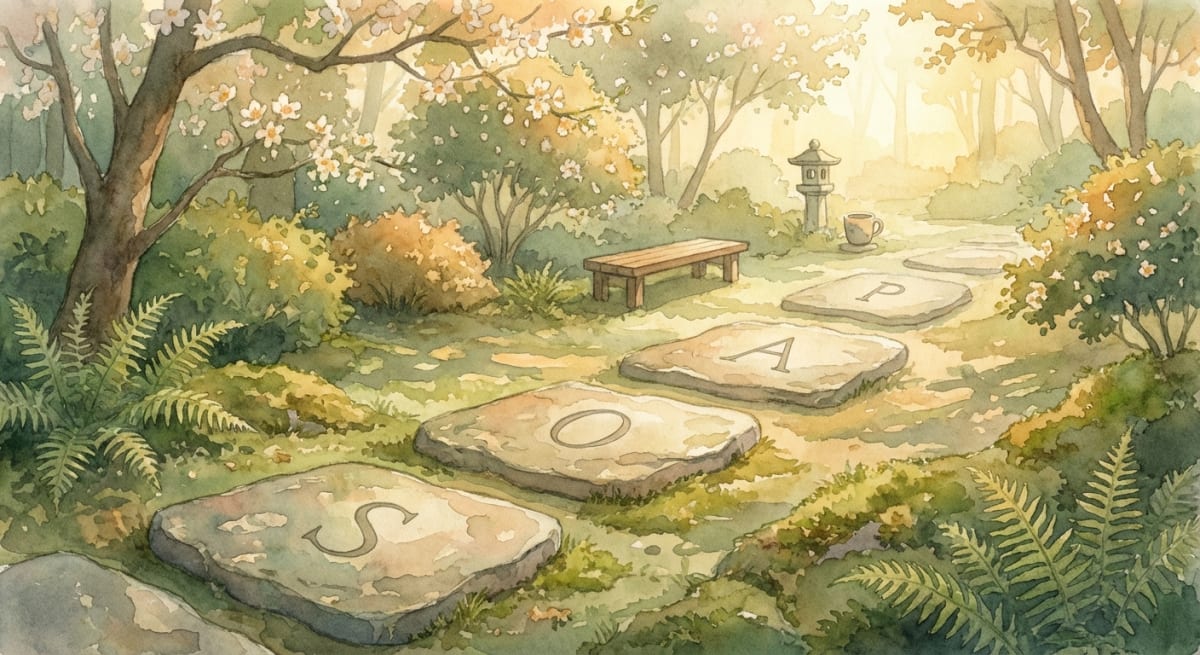
SOAP is an acronym that breaks Bible study into four manageable steps:
- S — Scripture: Read and write out a passage
- O — Observation: Notice what stands out
- A — Application: Connect it to your life
- P — Prayer: Respond to God
That's it. Four steps. No complicated tools or special training required. The SOAP Bible study method works because it slows you down just enough to actually absorb what you're reading — instead of rushing through chapters on autopilot.
This approach is one of the most popular Bible study methods for a reason: it's flexible enough to use with any passage, any translation, and any schedule.
Why the SOAP Method Works So Well
Before we walk through each step, here's why SOAP has helped so many people study Scripture more meaningfully:
- It's simple to remember. Four letters, four steps. You'll have it memorized after one session.
- It works with any passage. Whether you're in Genesis or Revelation, SOAP applies.
- It engages your whole self. You read, think, reflect, and pray — not just skim.
- It creates a written record. Over time, your journal becomes a personal commentary.
- It fits any schedule. You can SOAP a single verse in 10 minutes or a full chapter in 30.
If you've struggled with how to read the Bible without zoning out, SOAP might be exactly what you need.
Step-by-Step SOAP Bible Study Guide
Let's walk through each step in detail so you can start using this method today.

S — Scripture: Read and Write It Out
Start by choosing a passage. This could come from your daily reading plan, a book you're working through, or even a verse that caught your attention at church.
Here's the key: write it out by hand. Don't just read it on a screen and move on. The physical act of writing slows your brain down and helps you process the words more carefully.
Practical tips:
- Keep it short — 1 to 5 verses is plenty
- Use a translation you can easily understand (NIV, NLT, or ESV work great)
- Don't worry about perfect handwriting — this is for you
O — Observation: Look Closely at What You Read
Now read through what you wrote and ask yourself: What do I notice?
This isn't about finding the "right" answer. It's about paying attention. Here are some questions to guide your observations:
- Who is speaking or being spoken to?
- What is happening in this passage?
- When and where does this take place?
- Are there any repeated words or phrases?
- What themes or contrasts do you notice?
- Is there a command, promise, or warning?
Write down everything that stands out — even things that seem obvious. You'd be surprised how much you miss when you just read quickly.
A — Application: Make It Personal
This is where Scripture moves from the page into your life. Ask yourself:
- How does this apply to me today?
- Is there a behavior I need to change?
- Is there a promise I can hold onto?
- Does this challenge something I've been thinking or doing?
- How does this shape the way I see God, myself, or others?
Be specific. Instead of writing "I should pray more," try "I want to start my mornings with 5 minutes of prayer before checking my phone." The more concrete your application, the more likely you are to actually follow through.
If you're looking for ways to build a consistent Scripture habit, our guide on how to start a daily Bible reading habit has some practical tips that pair well with the SOAP method.
P — Prayer: Talk to God About What You Learned
Close your SOAP time by praying through what you've just studied. This doesn't need to be long or formal. Simply talk to God about:
- What you observed in the passage
- How you want to apply it
- Any struggles or questions it raised
- Gratitude for what He's showing you
Prayer turns study into conversation. It's the step that transforms Bible reading from an academic exercise into a relationship with God.
SOAP Bible Study Example: Philippians 4:6-7
Let's put the method into practice with a real passage so you can see exactly how it works.
S — Scripture
"Do not be anxious about anything, but in every situation, by prayer and petition, with thanksgiving, present your requests to God. And the peace of God, which transcends all understanding, will guard your hearts and your minds in Christ Jesus." — Philippians 4:6-7 (NIV)
O — Observation
- Paul is writing to the church in Philippi — people he deeply cares about
- "Do not be anxious about anything" — that's a broad statement, no exceptions listed
- The remedy for anxiety isn't "try harder" — it's prayer with thanksgiving
- There's a promised result: peace that "transcends all understanding"
- That peace guards hearts and minds — it's active protection, not passive
A — Application
I've been anxious about a decision at work this week. Instead of overthinking it alone, I want to bring it to God in prayer — specifically with gratitude for what's already going well. I'm going to write out three things I'm thankful for before I pray about the decision tonight.
P — Prayer
Lord, thank you for this reminder that I don't have to carry my anxiety alone. I bring my worries about this week to you. Thank you for your faithfulness so far. Please guard my heart and mind with your peace — the kind I can't manufacture on my own. Amen.
See how natural that felt? That's the beauty of SOAP. It doesn't require special knowledge — just willingness to show up and engage.
Tips for SOAP Bible Study Beginners
If you're just getting started, here are a few things that will help:
- Start small. One verse is enough. You can always add more later.
- Use a dedicated journal. Keeping your SOAP entries in one place creates a powerful record of your spiritual growth.
- Don't overthink it. There's no wrong way to observe or apply. Just be honest.
- Be consistent, not perfect. If you miss a day, pick up where you left off. No guilt.
- Pair it with a reading plan. Using SOAP alongside a structured plan like BibleMate's free reading plan gives you daily passages to work with.
- Try it during your morning devotional. SOAP fits naturally into a quiet time routine.
SOAP vs Other Bible Study Methods
SOAP isn't the only way to study Scripture, and it doesn't have to be. Here's a quick comparison:
| Method | Best For | Time Needed |
|---|---|---|
| SOAP | Daily personal study | 10–30 min |
| Inductive Study | Deep analysis of a book | 30–60 min |
| Lectio Divina | Meditative, contemplative reading | 15–30 min |
| Verse Mapping | Visual learners | 20–45 min |
| Topical Study | Exploring a specific theme | 30–60 min |
Each method has its strengths. Many people use SOAP as their everyday method and switch to deeper approaches when studying a particular book or topic. You can explore more in our complete guide to Bible study methods.
How to Start Your SOAP Bible Study Tomorrow
Ready to give it a try? Here's your simple action plan:
- Grab a notebook (or open a notes app — whatever works for you)
- Pick a passage — Philippians 4:6-7 is a great one to start with
- Set aside 15 minutes — that's all you need
- Write S-O-A-P down the left side of your page
- Work through each step — no rushing, no pressure
And if you're looking for a daily passage to SOAP through, BibleMate's free Bible reading plan gives you a balanced selection of Old Testament, New Testament, and Wisdom literature every single day — no account needed, no ads, completely free.
You don't need to be a scholar to study the Bible well. You just need a willing heart, a pen, and four simple steps. You can do this — and we're cheering you on.
Frequently Asked Questions
What does SOAP stand for in Bible study?
SOAP stands for Scripture, Observation, Application, and Prayer. It's a four-step method where you read a passage, observe what stands out, apply it to your life, and respond in prayer. It's designed to help you go deeper with any Bible passage in a simple, structured way.
How long does a SOAP Bible study take?
Most people spend 10 to 30 minutes on a SOAP session, depending on the length of the passage. If you're short on time, you can SOAP a single verse in about 10 minutes. There's no minimum — even a brief session is more valuable than skipping altogether.
Do I need a special journal for SOAP Bible study?
Not at all. Any notebook, blank journal, or even a notes app works perfectly. Some people enjoy using a dedicated SOAP journal to keep their entries organized, but it's completely optional. The method matters more than the materials.
Can beginners use the SOAP method?
Absolutely — SOAP is one of the most beginner-friendly Bible study methods available. You don't need any prior Bible knowledge or theological training. If you can read, write, and reflect, you can SOAP. It's actually one of the best ways to learn how to study the Bible for the first time.
What's the difference between SOAP and inductive Bible study?
SOAP is a simplified daily devotional method focused on personal reflection, while inductive Bible study is a more detailed analytical approach that examines context, word meanings, and cross-references. Think of SOAP as your everyday tool and inductive study as your deep-dive tool — both are valuable, and they complement each other well.
Can I use SOAP with a Bible reading plan?
Yes, and many people find this combination especially effective. A reading plan gives you daily passages to work with, and SOAP gives you a framework to engage with them deeply. BibleMate's free reading plan pairs naturally with the SOAP method — pick one or two verses from your daily reading to SOAP through.
Related on BibleMate
Keep exploring related topics, plans, and lists.
Get the BibleMate App
Take your Bible reading anywhere. Track progress, build streaks, and stay on plan — all from your phone.
Ready to start your Bible reading journey?
Read the entire Bible in one year with daily guidance.