Bible Study Notes: How to Take Better Notes (2026)
TL;DR
Learn how to take Bible study notes that actually help you remember and apply Scripture. Simple methods, templates, and tips for any reader.
Bible Study Notes: How to Take Notes That Deepen Your Understanding
Do you read the Bible but forget what you read almost immediately? You're not alone. Most people struggle to remember what they've read.

The solution is simple: take bible study notes. Writing things down helps you remember them. It helps you understand them better. And it helps you actually live out what you read.
Let's make this easy and doable for you.
Why Take Bible Study Notes?
Your brain remembers better when you write things down. Here's why note-taking works:
You Remember More:
- Writing uses different parts of your brain than just reading
- You're 23% more likely to remember what you write down
- Notes help you recall insights weeks later
You Understand Deeper:
- Writing forces you to think about what you're reading
- You notice things you missed when just reading
- You connect verses to your real life
You See Growth:
- Looking back at old notes shows how you've grown
- You see patterns in what God is teaching you
- You have proof of answered prayers and insights
You Pray Better:
- Your questions become prayers
- Your insights become reasons to praise God
- Your applications become specific requests for help
What Should You Write Down?
Don't try to write everything. Focus on these four things:
1. What You Notice
- Words or phrases that stand out
- Things that surprise you
- Patterns you see (repeated words, themes)
- What this teaches you about God
2. Questions You Have
- "What does this word mean?"
- "How does this apply to my life?"
- "Why did this person do that?"
- "What does this mean for today?"
3. How It Applies to You
- Specific things you need to do
- Attitudes you need to change
- Ways to treat people better
- Areas where you need to trust God more
4. Other Verses It Connects To
- Similar stories in other books
- Verses that say something related
- Different perspectives on the same topic
5 Simple Note-Taking Methods
1. SOAP Method (Best for Beginners)
S.O.A.P. = Scripture, Observation, Application, Prayer
Here's how:
- Scripture: Write out 1-2 verses that stood out
- Observation: What do you notice about these verses?
- Application: How does this apply to your life?
- Prayer: Talk to God about what you learned
Example:
- Scripture: "Cast all your anxiety on him because he cares for you" (1 Peter 5:7)
- Observation: God actually cares about my worries
- Application: I need to pray about my job stress instead of just worrying
- Prayer: God, help me give you my work worries and trust that you care
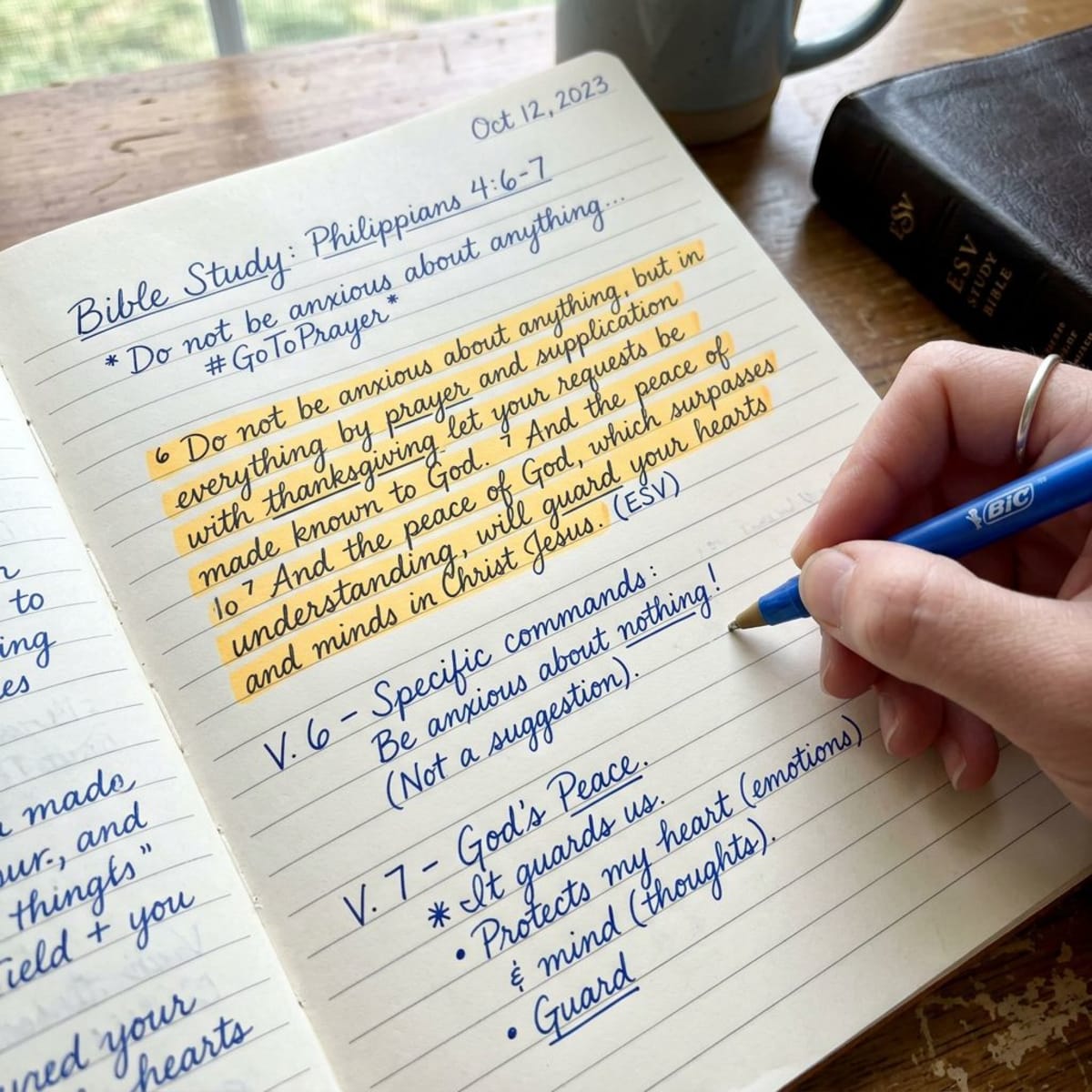
2. Simple Margin Notes
Just write in the margins of your Bible. Keep it simple:
Use these symbols:
- ⭐ = Important verse
- ? = Question or confusion
- ! = Surprising insight
- ❤️ = Encouraging verse
- → = Reminds me of another verse
Write short notes:
- "Trust God more"
- "Like David's situation"
- "For my marriage"
- "Answered prayer!"
3. One-Verse Focus
Pick one verse from your reading and explore it deeply:
- Write the verse in the middle of your page
- Circle important words
- Define unfamiliar words
- Think about what it means
- Write how it applies to you
Great for: Understanding difficult verses, memorizing Scripture
4. Journal Style
Write like you're talking to a friend. Ask yourself:
- "What did I learn about God today?"
- "How do I feel about this passage?"
- "What do I need to do differently?"
- "Dear God, this made me think..."
Perfect for: Processing emotions, building a prayer habit
5. Digital Notes
Use apps on your phone or computer:
Popular options:
- YouVersion Bible App - highlight and add notes right in the app
- Phone notes app - simple and always with you
- Evernote or Notion - organize by topics
- Google Docs - searchable and backed up
Good for: People who prefer typing, want to search old notes
Advanced Note-Taking Techniques
Once you're comfortable with basic note-taking, try these advanced methods:
Verse Mapping
Create a visual map of one important verse:
- Write the verse in the center of your page
- Draw branches connecting to key words
- Research each word using a Bible dictionary or reliable Bible study tools
- Connect to other verses that use the same words
- Note historical context if it helps understanding
Example with Philippians 4:13:
- "I can" → What can you do?
- "do all things" → What specific things?
- "through Christ" → How does Christ give strength?
- "who strengthens me" → Past examples of God's strength
Cross-Reference System
Build connections between verses:
- When you find a verse about a topic (like prayer), write related verses in the margin
- Use different colors for different topics (blue for faith, green for hope, red for love)
- Create a simple index at the back of your notebook with page numbers for major themes
Question Progression Method
Turn your questions into research projects:
- Write your question (Why did Jesus weep?)
- List what the passage tells you (Lazarus died, people were mourning)
- Research background (Jewish burial customs, Jesus' emotions)
- Find related passages (other times Jesus showed emotion)
- Write your conclusion (Jesus feels deeply about human suffering)
Note Organization Systems
The Three-Column Method
Divide your page into three columns:
| Passage | Personal Insight | Action Step |
|---|---|---|
| Matt 6:26 (birds) | God cares about details | Stop worrying about money this week |
| 1 Thess 5:16-18 | Joy and prayer go together | Pray when frustrated instead of complaining |
Topical Collection System
Create dedicated sections for:
- God's Character - verses that show who God is
- Promises - what God promises to do
- Commands - things God asks us to do
- Examples - how biblical characters handled situations
- Personal Growth - areas where you're growing
The Dating and Tagging System
For every note, include:
- Date you read it
- Life situation tag (#stressed, #grateful, #confused)
- Bible book abbreviation (Rom for Romans)
- Main topic (#prayer, #faith, #relationships)
Example note:
2/28/26 #stressed Rom8:28 - God works everything for good. Even this work situation. #trust #sovereignty
This system helps you search for notes when facing similar situations months later.
Review and Reflection Strategies
Weekly Review Sessions
Every Sunday, spend 15 minutes:
- Read through the week's notes
- Identify patterns - What is God teaching you repeatedly?
- Check progress - Did you apply anything you wrote down?
- Pray about themes that keep coming up
- Plan for next week - What do you want to focus on?
Monthly Deep Dives
Once a month:
- Re-read a month of notes
- Look for spiritual growth - How have you changed?
- Identify unanswered questions - Research them this month
- Celebrate answered prayers - Write them in a special section
- Set new goals based on what you're learning
The Spiral Method
Keep coming back to important insights:
- Mark significant notes with a star or highlight
- Review starred notes monthly
- Add new thoughts in different colored ink
- Watch insights deepen over time
Example progression:
- Month 1: "God is good" (basic truth)
- Month 3: "God is good even when life is hard" (deeper understanding)
- Month 6: "God's goodness means I can trust Him with unclear situations" (personal application)
Creating Personal Study Guides
Turn your notes into study guides for future reference:
For Bible books you've finished:
- Main themes you discovered
- Key verses that stood out
- Personal applications you're still working on
- Questions you'd like to explore more
For topics that keep coming up:
- All verses you've found on the topic
- Different perspectives from various Bible authors
- How your understanding has grown
- Specific ways to apply this truth
This creates a personalized reference library that reflects your unique journey with God's Word.
Setting Up Your Note-Taking System
For Paper Notes
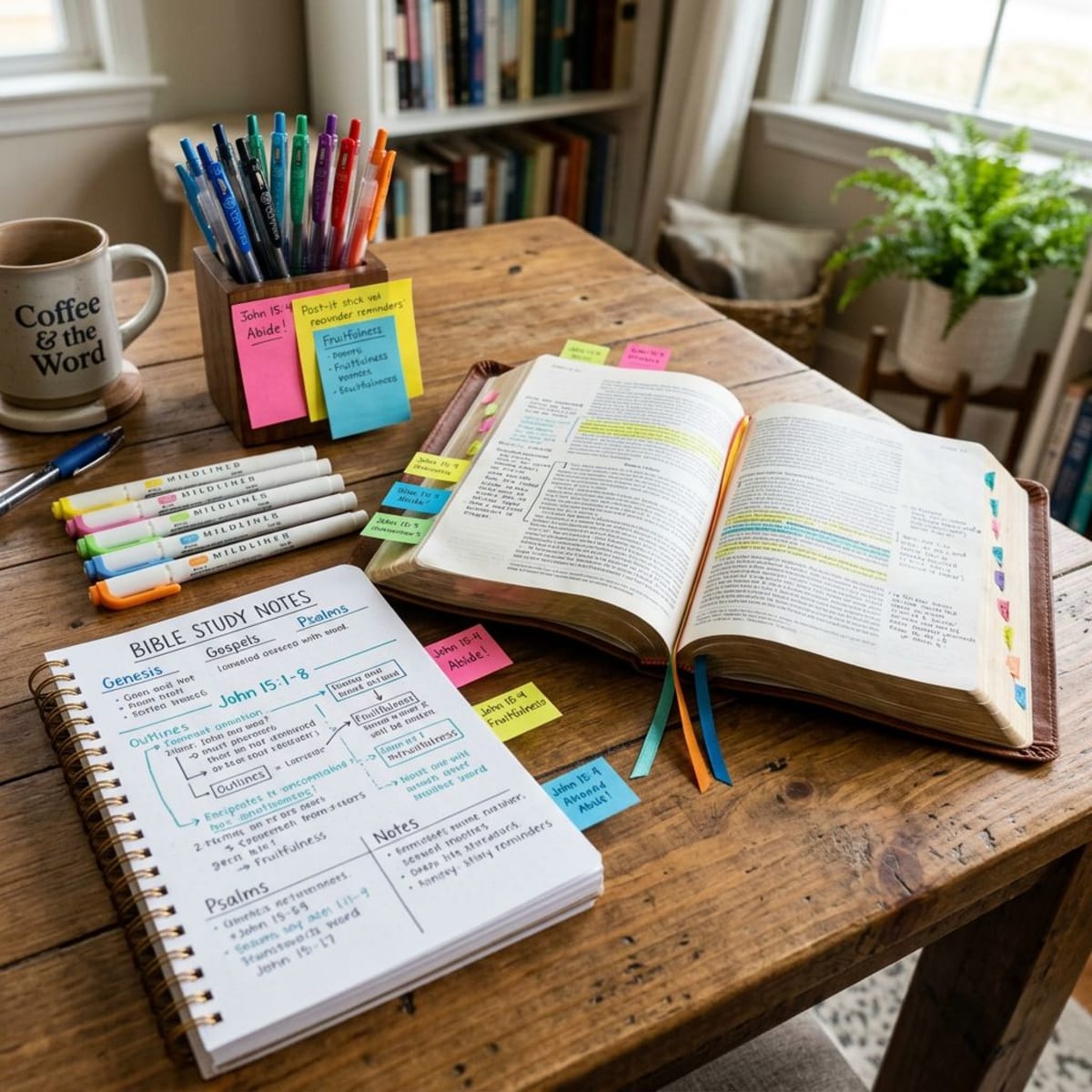
You need:
- A notebook you like (doesn't need to be fancy)
- 2-3 pens in different colors
- Some highlighters (optional)
- Access to helpful Bible study tools when you need to research difficult passages
Organization ideas:
- By date - just write chronologically like a journal
- By Bible book - separate sections for each book you're studying
- By topic - sections for prayer, faith, relationships, etc.
Keep it simple! Don't overthink the organization. Just start writing.
For Digital Notes
Create folders for:
- Daily Bible reading notes
- Book studies (if you're studying specific books)
- Prayer requests
- Favorite verses
Important: Back up your notes! Use cloud storage so you don't lose everything if your device breaks.
Paper vs Digital: Which Is Better?
Paper Notes Are Better For:
- Remembering more - handwriting helps your brain remember
- Fewer distractions - no notifications while you write
- Always available - no battery needed
- Personal connection - many people feel more connected when writing by hand
Digital Notes Are Better For:
- Searching old notes - find anything instantly
- Never losing them - automatic backup
- Sharing with friends - easy to copy and send
- Taking anywhere - available on all your devices
Try Both!
Many people use both:
- Write by hand during Bible reading (better focus)
- Type important insights later (to save and search)
- Use digital for research and cross-references

How to Build the Note-Taking Habit
Start Super Small
- Week 1: Write just one sentence after reading
- Week 2: Add one question you have
- Week 3: Add one way it applies to your life
- Week 4: Add a short prayer
This gradual approach works perfectly when you're learning how to start daily Bible reading - both habits support each other for lasting spiritual growth.
Don't try to do everything at once. Build the habit slowly.
Pick One Method and Stick With It
Don't jump between different note-taking styles. Pick one that feels comfortable and use it for at least a month.
Set Realistic Goals
- Beginners: 1-2 sentences per day
- Getting comfortable: One short paragraph
- Experienced: Whatever feels natural
Review Your Notes
- Weekly: Look back at what you wrote this week
- Monthly: Look for patterns and themes
- When struggling: Read old notes for encouragement
Common Mistakes to Avoid
Trying to Write Everything Down
Problem: Attempting to capture every detail, feeling overwhelmed by too much information
What this looks like: Taking 30 minutes to write a page of notes for 3 verses
Better approach: Focus on 1-2 things that really stood out to you personally
Practical tip: Set a 5-minute timer for note-taking. When it goes off, finish your current thought and stop.
Never Looking Back at Notes
Problem: Writing notes but never reviewing them, missing spiritual growth patterns
What this looks like: Notebooks full of notes that you never open again
Better approach: Schedule 10 minutes each week to read old notes
Practical tip: Write "Review last week's notes" on your Sunday calendar
Comparing Your Notes to Others
Problem: Feeling like your notes aren't good enough when you see others' elaborate systems
What this looks like: Seeing someone's beautiful Bible journal on social media and feeling discouraged
Better approach: Remember this is about your growth, not competing with others
Practical tip: Focus on one simple question: "Am I understanding and applying God's Word better than last month?"
Making It Too Complicated
Problem: Creating complex systems that are hard to maintain when life gets busy
What this looks like: Color-coded systems with 12 different categories that take 20 minutes to set up
Better approach: Keep it simple and focus on consistency over perfection
Practical tip: If your system takes more than 2 minutes to set up, it's too complicated
Skipping Application
Problem: Writing observations but never thinking about life change
What this looks like: Notes that read like a Bible commentary but never address your real life
Better approach: Always ask "How does this change how I should live?"
Practical tip: End every note session by writing one specific thing you'll do differently this week
Perfectionism Paralysis
Problem: Not starting because you want the "perfect" note-taking method first
What this looks like: Spending weeks researching systems instead of actually taking notes
Better approach: Start with any simple method today, improve as you go
Practical tip: Give yourself permission to be messy for the first month while you figure out what works
Information Without Transformation
Problem: Collecting interesting facts about the Bible without letting it change your heart
What this looks like: Notes full of historical context and word definitions but no personal reflection
Better approach: Balance learning facts with asking "What is God saying to me through this?"
Practical tip: For every factual note you write, add one sentence about how it affects your relationship with God
Simple Tips for Success
Keep Supplies Handy
Put your notebook and pen with your Bible. Make it as easy as possible to take notes.
Don't Worry About Perfect Handwriting
Your notes are for you. Messy writing is fine if you can read it.
Use Questions as Prayer Starters
When you write down a question, pray about it. Ask God to help you understand. This connects your note-taking with your morning devotional routine for deeper spiritual growth.
Connect to Real Life
Always try to connect what you read to something happening in your actual life right now.
Be Honest in Your Notes
Write about struggles, doubts, and confusions. God can handle your honesty.
Getting Started This Week
Here's your simple action plan:
- Choose your method - SOAP is great for beginners
- Get your supplies - notebook and pen, or choose a digital app
- Start tomorrow with just one sentence of notes
- Try it for one week before deciding if you like it
- Adjust as needed - make it work for your life
Remember: The best note-taking system is the one you'll actually use. Start simple and build from there.
Common Questions
How long should my notes be?
Start with just one or two sentences. Don't pressure yourself to write a lot. Quality matters more than quantity.
What if I miss days?
That's completely normal! Don't guilt yourself. Just start again the next time you read. Progress, not perfection.
Should I take notes on every verse?
No way! Focus on verses that stand out to you, surprise you, or speak to your current situation.
Can I use different methods for different books of the Bible?
Absolutely! Use whatever method fits what you're reading. Stories might work better with journaling. Difficult passages might need the SOAP method.
What if my handwriting is terrible?
That's fine! Your notes are for you. If you can read it, it works. If handwriting is really a problem, try digital notes.
How do I make time for notes when I'm already busy?
Start with 30 seconds. Write one thing that stood out. Even this tiny step will help you remember more and can grow over time.
Start Today
Bible study notes don't need to be perfect, long, or complicated. They just need to happen.
Pick the simplest method that appeals to you. Get whatever supplies you need. Start tomorrow with just one sentence.
The goal isn't to impress anyone or create beautiful notes. The goal is to help you remember and live out what you read.
Your relationship with God's Word will get stronger when you start writing down what He shows you.
Ready to start building a stronger Bible reading habit? Start reading the Bible regularly and practice taking simple notes as you go. You'll be amazed at how much more you remember and apply.
Related on BibleMate
Keep exploring related topics, plans, and lists.
Bible Verses About Love
Discover powerful Bible verses about love — God's love for us, loving others, and the greatest commandment.
All 66 Books of the Bible
Complete list of every book in the Bible in order — Old and New Testament with author, chapters, and genre.
Chronological Bible Reading Plan
Read the Bible in the order events actually happened — perfect for understanding the full narrative arc.
How to Read the Bible Daily: 15 Tips
Practical tips for building a daily Bible reading habit that actually sticks.
Get the BibleMate App
Take your Bible reading anywhere. Track progress, build streaks, and stay on plan — all from your phone.
Ready to start your Bible reading journey?
Read the entire Bible in one year with daily guidance.