How to Memorize Bible Verses: 7 Easy Methods (2026)
TL;DR
Struggling to memorize Scripture? Try these 7 proven methods for Bible verse memorization, from flashcards to song. Find what works for you.
How to Memorize Bible Verses: 7 Proven Methods That Actually Work
Have you ever wanted to carry a favorite verse with you — not just in your phone, but in your heart? Learning how to memorize bible verses is one of the most rewarding things you can do for your spiritual life. Whether you're looking for comfort during hard times, wisdom for daily decisions, or simply want to meditate on God's Word more deeply, scripture memory is a gift you give yourself.
And here's the good news: you don't need a perfect memory to make it happen. You just need a method that fits you.

In this guide, we'll walk through seven proven bible memorization techniques — from classic flashcards to creative approaches like singing and visual mapping. No matter your learning style, there's something here for you. Let's dive in!
Why Memorize Scripture?
Before we get into the methods, let's talk about why this matters. Memorizing Bible verses isn't about impressing anyone or checking a box. It's about:
- Finding comfort when you need it most — When anxiety or grief hits, a memorized verse becomes an anchor you can hold onto instantly.
- Growing spiritually — Meditating on God's Word transforms how you think and respond to life.
- Making better decisions — Scripture gives you wisdom that's always accessible, no Bible app required.
- Deepening your prayer life — Praying God's own words back to Him is a powerful practice.
If you're already working through a daily Bible reading plan, adding even one memorized verse per week takes your journey to the next level.
The 7 Proven Methods for Bible Verse Memorization
1. Write It Out by Hand
There's real science behind this: handwriting activates parts of the brain that typing doesn't. When you physically write a verse, you process it more deeply.
How to do it:
- Choose your verse (start short — one or two sentences).
- Write it out completely, 5–10 times in a row.
- After each round, try writing it from memory.
- Repeat daily until you can write it without looking.
Try it with: "Trust in the Lord with all your heart, and do not lean on your own understanding." — Proverbs 3:5-6
This method works especially well for kinesthetic learners — people who learn best by doing. Keep a small journal just for scripture memory, and you'll be surprised how quickly verses stick.
2. Read Aloud 10x, Recite 10x
This is the "brute force" method, and it's wonderfully simple. Repetition is one of the oldest and most effective memory tools we have.
How to do it:
- Read the verse aloud 10 times, slowly and clearly.
- Close your Bible and try to recite it 10 times from memory.
- If you get stuck, peek — then start the recitation count over.
- Do this once in the morning and once before bed.
Most people can memorize a single verse in 2–3 days with this approach. It's perfect if you like straightforward, no-frills methods.
3. Flashcards (Physical or Digital)
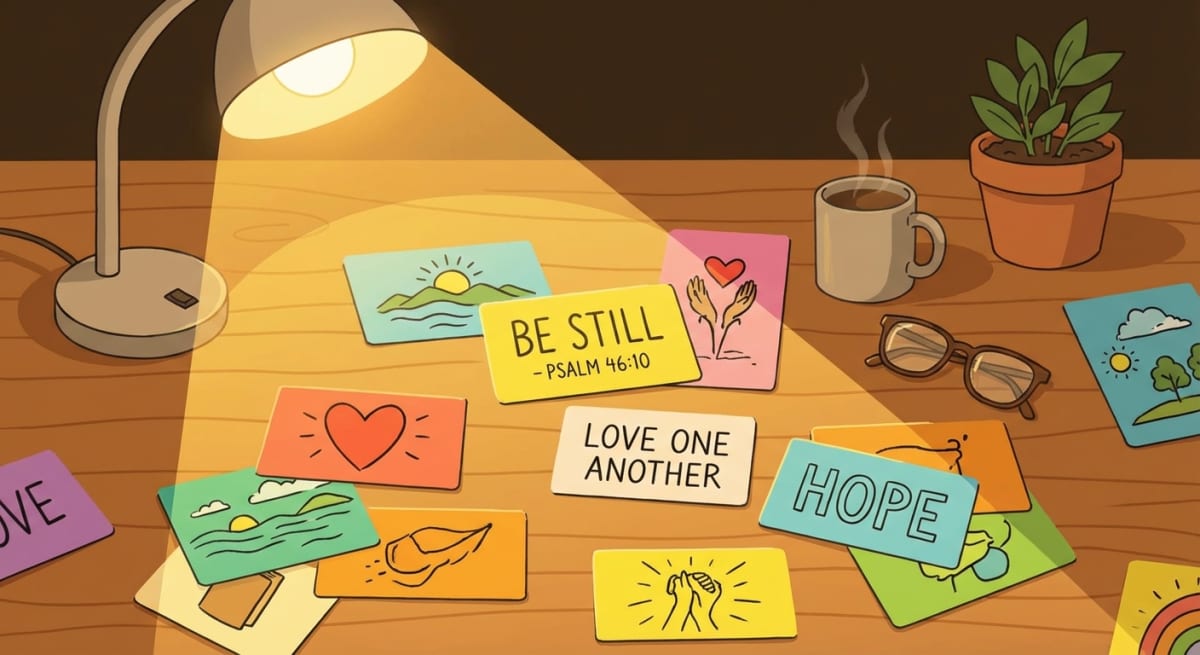
Flashcards are a tried-and-true scripture memory tool — and they're more versatile than you might think.
How to do it:
- Write the verse reference on the front of a card.
- Write the full verse on the back.
- Carry a few cards with you and review during spare moments — waiting in line, on your commute, during lunch.
- Once you know a verse well, move it to a "review" pile and check it weekly.
Pro tip: You can also use free flashcard apps like Anki or Quizlet if you prefer digital. Some people even use dedicated Bible memory apps.
This method is great for visual learners who benefit from seeing the words repeatedly, and for anyone who wants to make use of small pockets of time throughout the day.
4. The First Letter Method
This clever technique gives your brain just enough of a prompt to recall the full verse. It's like training wheels for your memory.
How to do it:
- Write out the first letter of each word in the verse.
- Use these letters as prompts to recite the full verse.
- Practice until you don't need the letters anymore.
Example with John 3:16:
"For God so loved the world that He gave His only begotten Son..."
Becomes: F G s l t w t H g H o b S...
At first, the letters help you recall each word. Over time, the verse flows naturally without any prompts. It's a fantastic bridge between reading and full memorization.
5. Sing It

Ever notice how you can remember song lyrics from decades ago but forget what you read yesterday? That's because melody is one of the most powerful memory aids our brains have.
How to do it:
- Pick a familiar, simple tune (think "Amazing Grace," "Twinkle Twinkle Little Star," or any melody you love).
- Set the verse words to that melody.
- Sing it several times a day — in the shower, while cooking, on a walk.
- Don't worry about it being musically perfect. It just needs to stick!
This method is ideal for auditory learners and is surprisingly fun. Many people find that sung verses stay with them for years — even decades.
6. Visual Mapping
If you're a visual thinker, drawing the verse as a scene or diagram can make it unforgettable.
How to do it:
- Read the verse carefully and identify the key images or concepts.
- Sketch a simple scene or mind map that represents the verse. (Stick figures are perfectly fine!)
- Walk through your drawing as you recite the verse.
- The more vivid or funny your images, the better they'll stick.
Example with Psalm 23:1: "The Lord is my shepherd; I shall not want."
Draw a simple scene: a shepherd (God) with a sheep (you) in a green field, looking content with nothing missing. Every time you see that image in your mind, the verse comes with it.
You don't need to be an artist — rough sketches work just as well because your brain remembers your own images best.
7. Daily Review Chain
This is the "compound interest" method of bible memory verses. It's how you go from memorizing individual verses to building an entire collection.
How to do it:
- Week 1: Memorize one verse using any method above. Review it daily.
- Week 2: Add a new verse. Now review both daily.
- Week 3: Add another. Review all three daily.
- Continue adding one verse per week.
The daily review only takes a few minutes, even when your chain grows. After a year, you could have 50+ verses memorized — and that's a life-changing library of Scripture in your heart.
Key: Don't skip the review. It's the review that makes verses stick long-term, not just the initial learning.
Which Method Fits Your Learning Style?
Not sure where to start? Here's a quick guide:
- Visual learners → Flashcards, Visual Mapping, First Letter Method
- Auditory learners → Read Aloud 10x, Sing It
- Kinesthetic learners → Write It Out, Flashcards (physical)
- Reading/writing learners → Write It Out, First Letter Method
Many people find that combining two methods works best. For example, writing a verse out by hand and reviewing it with flashcards throughout the day is a powerful combo.
The most important thing? Pick the method that feels enjoyable — because you'll actually do it. If you're also building a broader Bible study plan, verse memorization fits naturally alongside your reading habit.
Best Verses to Start Memorizing
If you're new to scripture memory, start with short, meaningful verses that you'll actually use in daily life:
- Psalm 23:1 — "The Lord is my shepherd; I shall not want."
- Philippians 4:13 — "I can do all things through him who strengthens me."
- Proverbs 3:5-6 — "Trust in the Lord with all your heart, and do not lean on your own understanding."
- John 3:16 — "For God so loved the world, that he gave his only Son..."
- Romans 8:28 — "And we know that for those who love God all things work together for good."
These are short, powerful, and widely loved across all traditions. Once you've memorized a few of these, you can move on to longer passages — or even whole chapters! Check out our list of Bible verses for beginners for more ideas.
How to Make Memorized Verses Stick
Memorizing is one thing — keeping what you've memorized is another. Here are three keys to long-term retention:
Use Spaced Repetition
Instead of reviewing a verse 20 times in one day and never again, spread your reviews out:
- Day 1: Learn the verse
- Day 2: Review
- Day 4: Review
- Day 7: Review
- Day 14: Review
- Day 30: Review
Each review strengthens the memory trace. After several spaced reviews, the verse moves into long-term memory.
Understand What You're Memorizing
Context makes everything easier to remember. Before memorizing a verse, take a moment to understand:
- Who wrote it and why?
- What's happening in the surrounding passage?
- What does it mean for your life today?
When you understand a verse deeply, it's much harder to forget. This is where a good Bible reading habit naturally supports your memorization.
Find an Accountability Partner
Share your memorization goals with a friend, family member, or small group. Quiz each other, share progress, and encourage one another. Having someone to recite verses with makes the process more enjoyable — and much more consistent.
Common Mistakes to Avoid
As you begin your scripture memory journey, watch out for these common pitfalls:
- Trying to memorize too many verses at once. Start with one per week. Quality over quantity.
- Skipping review. New memorization without review is like filling a bucket with a hole in it. The review is non-negotiable.
- Not understanding the context. Memorizing words without meaning makes them harder to retain and easier to misapply.
- Giving up after forgetting. Everyone forgets — it's part of the process! Just pick the verse back up and review it again. It comes back faster each time.
Remember: this isn't a test. There's no grade. It's a practice of love and devotion, and it's okay to go at your own pace.
Frequently Asked Questions
How long does it take to memorize a Bible verse?
Most people can memorize a short verse (1–2 sentences) in 3–5 days with consistent daily practice. Longer passages may take 1–2 weeks. The key is daily repetition — even just 5 minutes a day makes a huge difference.
Can I memorize entire Bible chapters?
Absolutely! Many people have memorized entire chapters like Psalm 23, Romans 8, or 1 Corinthians 13. The trick is to go verse by verse, adding one at a time and reviewing the whole chain daily. It takes patience, but it's deeply rewarding.
What Bible version should I memorize from?
Choose the translation you read most often and enjoy the most. Popular choices for memorization include the ESV (precise and readable), NIV (easy flowing language), and KJV (poetic and traditional). The best version is the one you'll actually stick with.
What if I keep forgetting verses I've already memorized?
That's completely normal! Memory naturally fades without review. The solution is spaced repetition — review your memorized verses on a regular schedule (weekly for recent ones, monthly for older ones). Think of it like watering a garden.
Is it better to memorize individual verses or whole passages?
Both have value! Individual verses are great for beginners and for having go-to truths ready in your heart. Whole passages give you deeper context and a richer understanding. Start with individual verses and work up to passages as your confidence grows.
How can I memorize verses if I have a bad memory?
Here's the encouraging truth: almost everyone can memorize Scripture — it just takes the right method and consistent practice. If traditional repetition doesn't work for you, try singing the verse, drawing it, or using the first letter method. Your memory is stronger than you think!
Start Your Scripture Memory Journey Today
Memorizing Bible verses is one of those practices that feels hard at first but becomes deeply rewarding over time. Each verse you tuck into your heart becomes a source of comfort, wisdom, and strength that you carry with you everywhere.
Pick one verse. Choose one method. Start today.
And if you're looking for a simple way to build a consistent Bible reading habit alongside your memorization practice, BibleMate offers a free 365-day reading plan that walks you through the entire Bible — one day at a time. No account needed, no cost, no pressure. Just you and God's Word.
You can do this. One verse at a time. 💛
Related on BibleMate
Keep exploring related topics, plans, and lists.
Get the BibleMate App
Take your Bible reading anywhere. Track progress, build streaks, and stay on plan — all from your phone.
Ready to start your Bible reading journey?
Read the entire Bible in one year with daily guidance.